
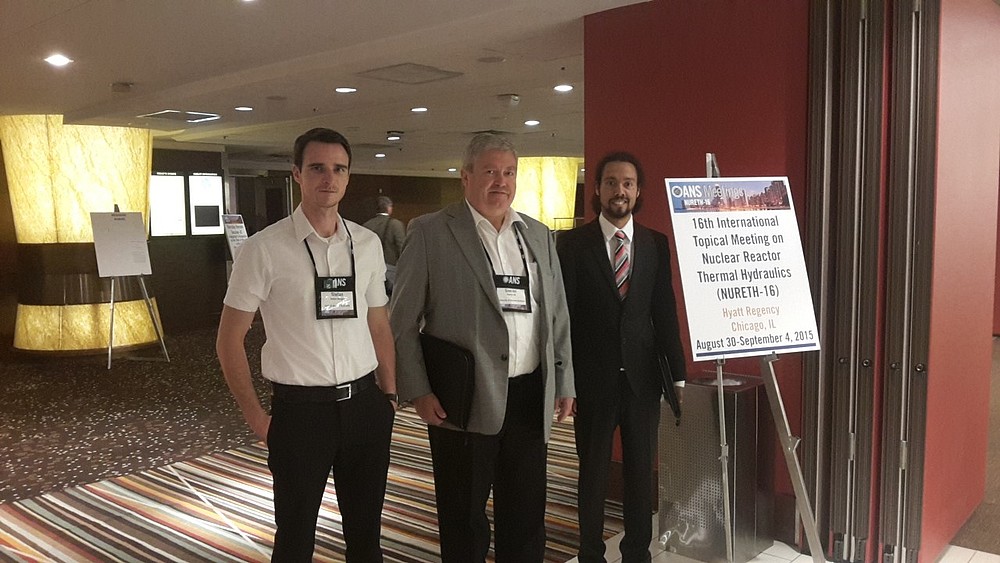
From the Nuclear Engineering/Soft Computing department of the Institute for Process Engineering, Process Automation, and Measurement Technology (IPM) at the university, Dr.-Ing. Stefan Renger, Dipl.-Ing. Sören Alt, and M. Eng. Hassan Chahi from the Department of Nuclear Engineering/Soft Computing at the Institute for Process Engineering, Process Automation, and Measurement Technology (IPM) at the university. This conference takes place every two years, alternating between Asia, Europe, and the Americas.
IPM staff presented findings from current research projects in the field of reactor safety, which are funded by the Federal Ministry of Education and Research (BMBF) and the Federal Ministry for Economic Affairs and Energy (BMWi).
In 2011, Germany decided to phase out the use of nuclear energy for electricity production. However, numerous experts will still be needed for decades to ensure the safe operation of nuclear power plants until the end of their operating lifetimes, as well as for their decommissioning and dismantling. In addition, Germany wishes to maintain the expertise necessary to assess the safety of nuclear technology that continues to evolve internationally (e.g., in our neighboring countries). Therefore, presenting our own current research findings and exchanging views on new results from other countries at international conferences is an effective way to maintain and further develop expertise in this field in line with the latest scientific and technological advancements.
At NURETH-16, Dr. Renger presented findings from the current BMWi project “Local Effects in the Pressurized Water Reactor (PWR) Core Resulting from Zinc Borate Deposits Following Loss-of-Coolant Accidents” in a special session on Generic Safety Issue 191 (GSI-191) addressed by the U.S. Nuclear Regulatory Commission, in which the U.S. side specifically addressed the issue of safe sump suction following a loss-of-coolant accident. This topic, which the IPM has been researching for many years, remains particularly relevant in the U.S. today.
In his presentation titled “System Analysis and Isothermal Separate Effect Experiments of the Accident Behavior in PWR Spent Fuel Storage Pools,” Mr. Chahi explained the insights gained so far from literature reviews and the results of the institute’s own single-effect studies, which were conducted as part of the BMBF collaborative project “Safety of Wet Storage Pools for Spent Fuel Elements: Experimental Analysis, Modeling, and Validation for System and CFD Codes” (SINABEL).
At the conference (particularly during the GSI-191 session), discussions were held not only on the topics presented but also on general issues in nuclear engineering research; existing contacts were maintained; and new connections were established with international researchers active in the field of thermohydraulics, with the possibility of future collaboration.
The projects mentioned in this article are funded by
under grant numbers 150 1431 and 150 1468, as well as
under grant number 02NUK027D.
Contact:
Prof. Dr.-Ing. Wolfgang Kästner
 Institute for Process Engineering, Process Automation, and Measurement Technology (IPM),
 w.kaestner@hszg.de
Phone: 03583 61 15 53