
Message details
Impressive project progress
The visit by the Federal Office for Radiation Protection to the HSZG focused on the precise detection of radioactive particles.
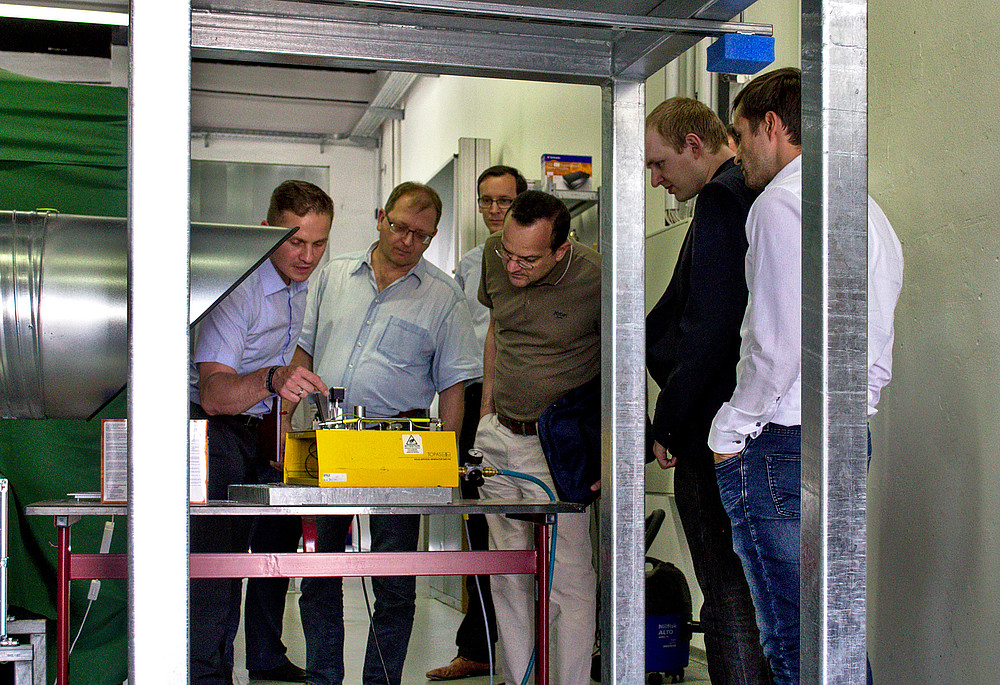
As part of the conversion of the former “Schacht Konrad” iron ore mine into a storage facility for low- and intermediate-level radioactive waste, the Institute for Process Engineering, Process Automation and Measurement Technology (IPM) is making a significant contribution to the safety of nuclear waste disposal. To this end, a model of the exhaust air system in Zittau—scaled down to one-fifth of its original size—was constructed by March 2019. There, state-of-the-art flow measurement techniques are used to study the behavior of particles drawn into the duct.
On July 2, the Federal Office for Radiation Protection (BfS) and the project partners—the Federal Company for Radioactive Waste Disposal (BGE) and VPC GmbH—visited the facility. The guests were impressed by the expertise and the extensive laboratories for research and teaching in the fields of reactor safety, interim and final storage, and radiation technology.
Prof. Alexander Kratzsch, project leader and director of the IPM, first welcomed the guests and opened the meeting. Following the introduction of the participants and the facilities, the BGE once again emphasized the motivation behind the project. The selected measurement position for detecting potential radioactive particles must allow for representative sampling and thus reliably identify any elements present in the exhaust air.
If radioactive particles are detected in the exhaust air, appropriate countermeasures can be implemented. The results of the experiments in the model duct will determine how the airflow management and sampling will be carried out in the original facility at “Schacht Konrad.”
The results of the experiments and the setup of the PIV (Particle Image Velocimetry) measurement system were presented by Dr. Clemens Schneider (IPM project manager). PIV is a method in which particles are introduced into a flow; by capturing successive images, the movement of the particles is recorded, thereby visualizing the velocity distribution within the flow.
The project partners were able to observe the corresponding experiments live during their visit.
The IPM’s expertise in the fields of thermohydraulics and flow measurement technology, as well as its many years of experience with high-resolution imaging measurement methods, were the deciding factors in awarding the project to Zittau.
To introduce the guests to the full scope of teaching and research activities in the field of radiation and nuclear engineering, Dr. Schneider organized the following additional program items:
- A guided tour of the current traveling exhibition “Radiation Research” led by Mr. Sören Alt
- Tour of the “Radiation Technology” laboratory at the Faculty of Mechanical Engineering, led by Prof. Thomas Schönmuth
- Presentation of the test facilities for investigating methods of condition monitoring for transport and storage containers for spent nuclear fuel and heat-generating high-level radioactive waste during extended interim storage, presented by Sebastian Reinicke and Daniel Fiß
- Presentation of the IPM Laboratory for Thermohydraulics by Mr. Alt, where issues related to reactor safety in beyond-design-basis and hypothetical accidents are investigated
Many thanks to our guests and all participants for their visit and the constructive discussions, including those on future educational opportunities in the field of radiation technology and radiation protection at HSZG.
Text: Kristin Sprechert, Clemens Schneider




Upper floor